
Herb Pilhofer
Inducted 2025
If The Herb Pilhofer Story ever becomes a movie, this will be the key scene: In the Spring of 1945 after Germany’s surrender, the citizens of war-ravaged Nuremberg/Fuerth waited for the arrival of the Allied Troops. Among them were 14-year-old Herb Pilhofer, a classically trained pianist, and his mother. After a deafening silence, a Jeep came around the corner blaring the song “Goody Goody” …and so began Herb’s 80-year love affair with music, but particularly Jazz.
From humble beginnings playing a tabletop keyboard called a tafelclavier, Herb soon taught himself jazz composition, arranging, improvisation, and he devoured jazz recordings while studying at the Nuremberg Music Conservatory. He formed his own combo and armed with abundant natural talent and motivation, he was soon featured nightly in an enlisted men’s service club in Nuremberg, as well as on a Sunday morning radio program, Herb’s Harmony Highlights, on The Armed Forces Radio Network in Europe.
Herb dreamed of immigrating to America, loving jazz and the freedom America offered. In 1954, sponsored by a bass-playing Army Captain, he settled in the Twin Cities. One of his first gigs was a comedy of errors, right here in New Ulm. Booked to play piano for a week at Esser’s Bar as “Herb Pilhoser…direct from Germany”, guests wanted polkas and waltzes- and maybe a guy in lederhosen. He was told by the owner, “Kid, you don’t cut the mustard… you’re fired!” The next day he went to local radio station KNUJ and listened to German drinking songs, which he’d never heard in Germany. He transcribed and played them, mixed with some jazz standards, and made it through the week.
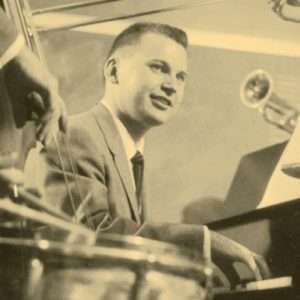
Herb also enrolled in the Music Department at The University of Minnesota. Though thoroughly at home in an academic world which included such “serious” composers as Paul Fetler and Dominick Argento, Herb left evening studies and teaching assignments behind to further his jazz education. In the 50’s and 60’s a jazz musician could make a living playing six nights a week at places like The White House, The Lipstick Lounge, Freddie’s and Herb’s Bar. For more than a decade, Herb headed one of the best jazz groups – trio, quartet, quintet, or octet- depending on the venue – in the Upper Midwest.
At the same time, he took his groups into the recording studio and released three well-received albums. His 1957 debut album, Jazz from the North Coast featured some of the best musicians the Twin Cities jazz scene had to offer. Pilhofer and his modern jazz group took over a significant part of the schedule at Minneapolis’ Walker Art Center Summer Jazz Series.
His 1959 release Trio was dubbed “best of the lot” by Metronome Magazine. Leonard Feather singled out Herb as “thee best new piano talent of the year” in Downbeat Magazine. In 1960 the Herb Pilhofer Trio released the nationally-distributed album Jazz, released on Chicago’s Argo Records label.
For Herb, it was a time of decision. The road to national recognition didn’t particularly interest him, so he stayed in the Twin Cities to raise his family, open to new opportunities. Advertisers and agencies began to seek him out to create music for radio and television. Big accounts like Pillsbury, Wrigley’s, 3M Company, Dairy Queen, Honeywell, Pan Am, Northwest Airlines and Dayton Hudson came his way. Never pigeon-holed, at the same time, he wrote a three-part suite for his jazz quartet and The Minneapolis Symphony Orchestra.
A man who has always thrived on taking risks and acting on gut instinct, Herb was immediately drawn to a new and very different project. The much-heralded Tyrone Guthrie Theater was about to open in Minneapolis and he was recruited as its first Music Director, despite having never seen a Shakespearean play. He subsequently helped design the Guthrie’s sound system, wrote the fanfare that was the Theater’s signature for over 50 years, and composed music for more than 15 productions over eight seasons. From jazz to jingles to the mainstage, Herb displayed the same versatility and creativity that has distinguished his entire career.
Years of experience in a recording studio stimulated his interest in putting together a state-of-the-art recording environment. Sound 80 Studios was founded in 1969 and moved to its new home, with five acoustically isolated studios stocked with the most advanced technology, in 1971. Mike Steele reported for the Minneapolis Tribune, “It’s a technological dream, a rocker’s paradise…a monument to recorded sound and an investment in the future of the recording industry”. Their full-page advertisement in Billboard Magazine on November 6, 1971 stated “Minneapolis is 1.2 miles from one of the country’s seven great recording studios”.
In 1976 he released Olympus One, which Herb wrote, arranged, and produced at Sound 80. The title track was commissioned by the United States Olympic Committee to promote the Montreal Summer Olympic Games. Described by Michael Anthony, of the Minneapolis Tribune as “stunning in arrangement and performance and a joy to listen to”.
Sound 80 recorded with more tracks and technology than any other studio, and the list of firsts and high-profile artists it boasted is astounding. He owned the first Moog Synthesizer and Synclavier in the Midwest, which put him on the map as a worldwide musical technological wizard.
Herb began working in collaboration with 3M in 1975, who had just invented multi-track digital recording. In the spring of 1978, 3M brought a prototype digital tape machine into Sound 80 (nicknamed “Herbie”). Through this collaboration, Sound 80 became the World’s First Digital Recording Studio, as heralded by Guinness. In the 15 years that the studio was in operation, artists such as Bob Dylan (Blood on the Tracks), Prince, Cat Stevens, Leo Kottke, John Denver, and Lipps Inc.’s Funkytown, recorded in the studio. Sound 80 recorded The Saint Paul Chamber’s Orchestra’s Appalachian Spring by Aaron Copland, which became the first piece of digital classical music to win a Grammy Award in 1980.
For Herb’s 1979 album, Spaces, he fronted 40-plus musicians to create what a reviewer called “a three-dimensional sound painting – a jazz landscape.” Consisting of six original and one co-written songs, it was also recorded on the new 32-track 3M Digital Mastering System.
But Pilhofer the musician was at odds with Pilhofer the business executive. It was an identity crisis resolved only with the dissolution of Sound 80 and creation of a scaled-down operation in his Minneapolis home studio. With engineer/sound designer son, Eric, his new venture, Pilhofer Music, allowed him to experiment and write as challenging projects came his way, and maintain a better work and life balance. In addition to many advertising scores for agencies around the country and clients such as Mercedes, Audi, American Express, Discover Card, US West, Budweiser and General Mills, there were countless feature, documentary, and commercial film scores, including Oscar nominated Always a New Beginning.
In 2001 at 70, after a 40-year detour, Herb was back on the jazz track with live performances by The Pilhofer Jazz Quartet at The Dakota Bar and Grill and the release of his new CD Full Circle. Gone were the synthesizers and lucrative commercial gigs. It was also a special opportunity to team up with his son Michael, a highly-regarded live and session jazz drummer. Full Circle was Herb doing what he was doing strictly for the sake of doing it… for his sake, and the music’s sake. With an immense sense of freedom he said, “Here’s what I love to do, folks. If you care to listen, I’ll do my damnedest.”
Herb used this “retirement” to pursue his passions more intentionally. Rarely without a camera bag, he was drawn to photography early in life. Nature, landscapes, architecture and family were his focus, and he replied to the protests of his children, “Someday you’ll thank me for this…”, and he was- as usual- 100% right. Frequent trips to Germany to see family and to share German culture with his American family was important to his soul. Adventuring to Africa, sailing in Lake Superior, and relaxing at the idyllic family retreat in Wisconsin inspired him.
With an extraordinary life worthy of a biopic, and five back-up drives of photography, Pilhofer decided to put together a memoir for his family. For his 80th birthday, he delivered Das Buch, a lavishly illustrated, lovingly assembled scrapbook of his life that shows everything from his father (who died before Herb was born), to a centerfold family tree, and thousands of curated photos.
After turning 88, Pilhofer came full circle again, returning to his roots as a jazz pianist. With one bad ear and one bad eye, he had to soak his arthritic hands in wax each morning to play the piano. But Herb was feeling great about performing in public for the first time in 18 years, at Crooners Supper Club in Fridley, Minnesota. In two sold out shows, surrounded by family and friends, he felt the support of the Minnesota musical community, recognizing faces spanning decades. “At this point of my life, I look at playing for me as a way of staying alive”, he said while sitting at the Bösendorfer grand piano in his home. “I don’t need my picture in Time Magazine. Never have. If I can play and somebody likes it, that’s wonderful.”
All professional accomplishments aside, without a doubt Herb feels the great achievement of his life is his family. Holidays are filled with great conversation, laughter, delicious food, and always German bretzen. His six children, 10 grandchildren, two great grandchildren and 45 year relationship with his amazing wife, RoseMary, bring him his greatest joy and reflect his life well-lived. His most recent project is the compositions for his daughter’s wedding in May, some of which was done in the hot tub! For most of his 94 years, Herb Pilhofer’s innovative spirit, keen mind, and prolific & visionary musical career have made him a highly-respected pioneer in Minnesota’s music industry. He is humbled and honored to be a part of it.
Thank you for sharing this with me. (Chuck)